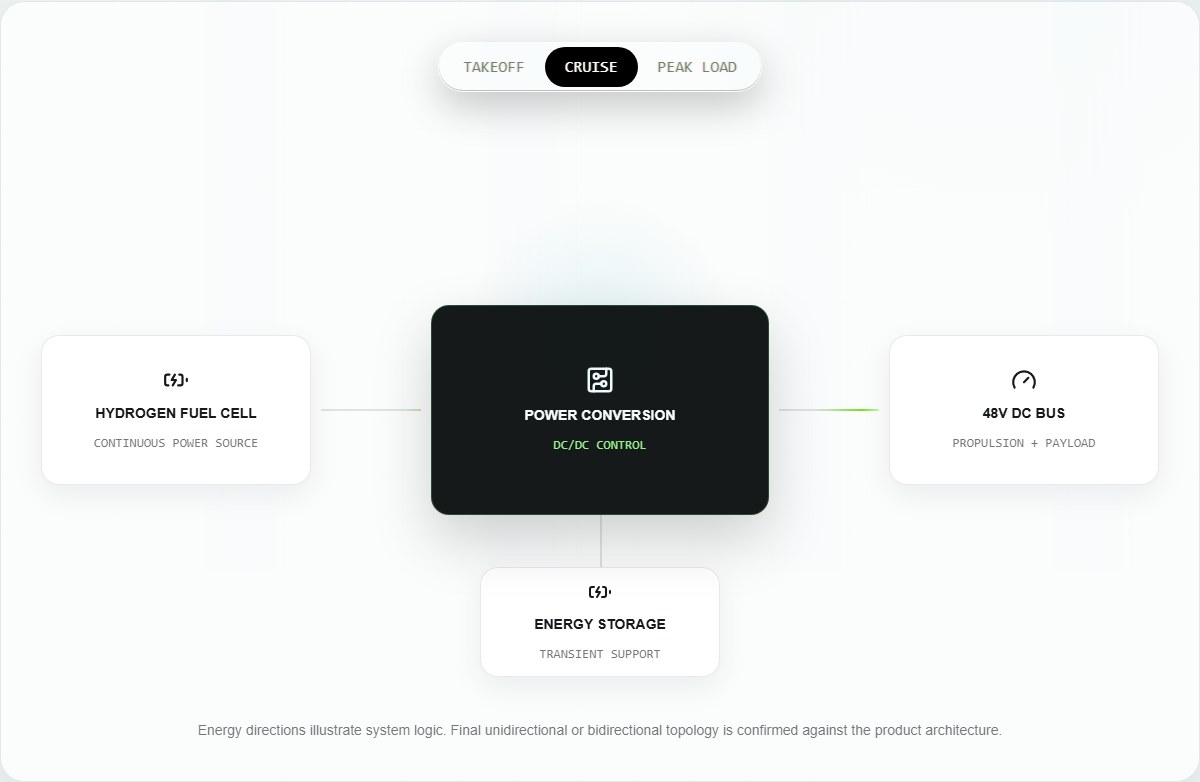
Connect flight lines, turns, climb and reserve to power demand.
Protect imaging, positioning and compute from bus disturbances.
Define telemetry and payload transfer loads by mission phase.
Account for wind, reroutes and incomplete coverage.
Build the electrical model from the survey plan
Area, ground sample distance, route spacing and operating altitude affect flight time and propulsion demand. Payload duty and onboard processing should be included in the same timeline.
Maintain a clean bus for precision payloads
GNSS, inertial, imaging and LiDAR equipment may require stable auxiliary rails and controlled electromagnetic behavior. Power conversion should be reviewed alongside grounding and harness architecture.
Engineering data policy: project limits and verified results are released only for the configuration they represent.
Use configuration-specific mission evidence
Coverage and endurance claims should identify aircraft, payload, route, weather and reserve assumptions. The converter configuration can then be validated against a traceable mission case.
Define the system boundary before freezing the hardware.
Golden Phoenix reviews electrical architecture, control, communication, mechanical integration and validation as one project configuration.
Inputs for technical review
- Survey area and route geometry
- Operating altitude and cruise profile
- Payload rails and peak demand
- Positioning and communication interfaces
- Wind and temperature assumptions
- Reserve and data-completion policy
Engineering FAQ
What defines Hydrogen UAV Power Systems for Mapping and Survey?
Mapping and survey missions reward predictable endurance and stable payload power. Route geometry, altitude, imaging cadence, compute and communication requirements define the useful electrical architecture.
Which information is required before configuration?
Survey area and route geometry; Operating altitude and cruise profile; Payload rails and peak demand; Positioning and communication interfaces; Wind and temperature assumptions; Reserve and data-completion policy
Are performance numbers fixed for every project?
No. Golden Phoenix releases efficiency, mass, thermal and dynamic-response values only for a confirmed project configuration.