Project-configurable voltage window confirmed from source behavior.
Regulation targets are defined against the aircraft electrical architecture.
Battery or supercapacitor coordination depends on the selected topology.
Telemetry, commands, alarms and fallback behavior are matched to the project.
Define topology before claiming direction
In hydrogen UAV systems, the fuel-cell branch and storage branch can have different power-flow directions. Unidirectional or bidirectional behavior should be confirmed from the system diagram, port count and control strategy.
Hold the DC bus during mission transients
Takeoff, climb, payload switching and propulsion load steps can change demand faster than the fuel cell prefers to respond. The converter and storage branch coordinate these events while keeping the aircraft bus inside its accepted window.
Engineering data policy: project limits and verified results are released only for the configuration they represent.
Release verified data only after configuration freeze
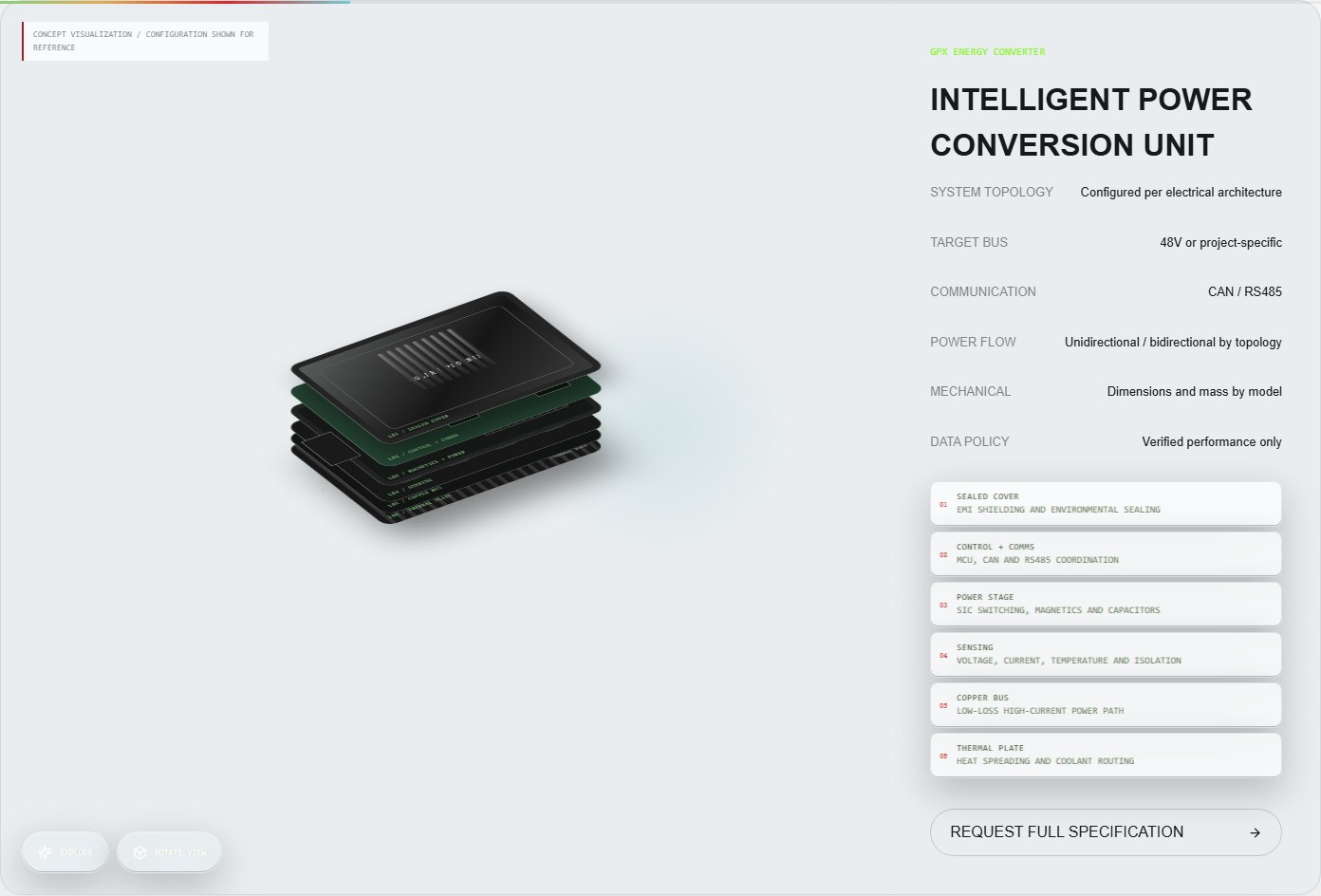
Efficiency, mass, thermal limits and dynamic-response waveforms should be attached to a controlled hardware, firmware, cooling and load condition. Golden Phoenix treats concept visuals as reference material until the project configuration is confirmed.
Define the system boundary before freezing the hardware.
Golden Phoenix reviews electrical architecture, control, communication, mechanical integration and validation as one project configuration.
Inputs for technical review
- Fuel-cell rated power and voltage range
- Aircraft bus voltage and regulation tolerance
- Continuous, peak and transient power demand
- Storage type and voltage window
- Power-flow direction by branch
- CAN / RS485 protocol and alarm behavior
Engineering FAQ
What defines Hydrogen UAV DC/DC Converter Engineering?
A hydrogen UAV DC/DC converter is the controlled energy interface between the fuel-cell source, storage branch and aircraft DC bus. Its real specification depends on topology, voltage window, transient demand, communication and cooling.
Which information is required before configuration?
Fuel-cell rated power and voltage range; Aircraft bus voltage and regulation tolerance; Continuous, peak and transient power demand; Storage type and voltage window; Power-flow direction by branch; CAN / RS485 protocol and alarm behavior
Are performance numbers fixed for every project?
No. Golden Phoenix releases efficiency, mass, thermal and dynamic-response values only for a confirmed project configuration.