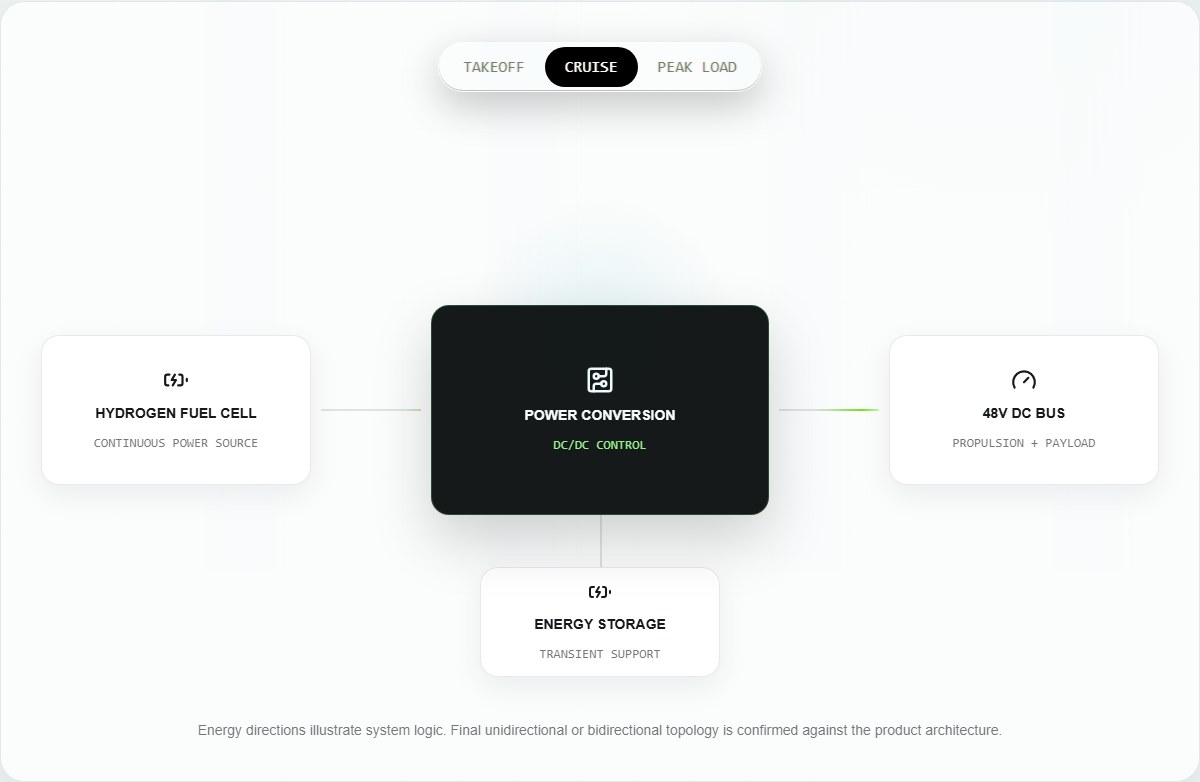
Operated within a project-defined voltage and dynamic envelope.
Supports peak demand and may absorb energy when topology permits.
Regulates source-to-bus behavior and exposes system state.
Supplies propulsion, avionics and mission equipment.
Choose topology before naming power direction
A fuel-cell branch is often unidirectional, while a storage branch may be bidirectional. The actual labels depend on port count, converter topology and the energy strategy. Bidirectional should never be used as a generic marketing claim.
Coordinate takeoff, cruise and recovery states
During takeoff and climb, storage can supplement the fuel cell. During cruise, the controller can return the source to an efficient operating region and manage storage state. Exact transitions are configured from verified aircraft data.
Engineering data policy: project limits and verified results are released only for the configuration they represent.
Design fault behavior as part of the architecture
Undervoltage, overcurrent, communication loss, temperature limits and emergency load shedding must be coordinated across the source, storage, converter and flight-energy controller.
Define the system boundary before freezing the hardware.
Golden Phoenix reviews electrical architecture, control, communication, mechanical integration and validation as one project configuration.
Inputs for technical review
- Branch-by-branch power direction
- Precharge and startup sequence
- Storage state-of-charge limits
- Peak-power duration and repetition
- Fault priorities and load shedding
- Ground-test and flight-validation plan
Engineering FAQ
What defines Fuel Cell and Battery Hybrid UAV Architecture?
A hybrid UAV combines the endurance potential of hydrogen fuel cells with the transient capability of an energy-storage branch. The architecture succeeds only when power direction, control authority and fault behavior are explicit.
Which information is required before configuration?
Branch-by-branch power direction; Precharge and startup sequence; Storage state-of-charge limits; Peak-power duration and repetition; Fault priorities and load shedding; Ground-test and flight-validation plan
Are performance numbers fixed for every project?
No. Golden Phoenix releases efficiency, mass, thermal and dynamic-response values only for a confirmed project configuration.